

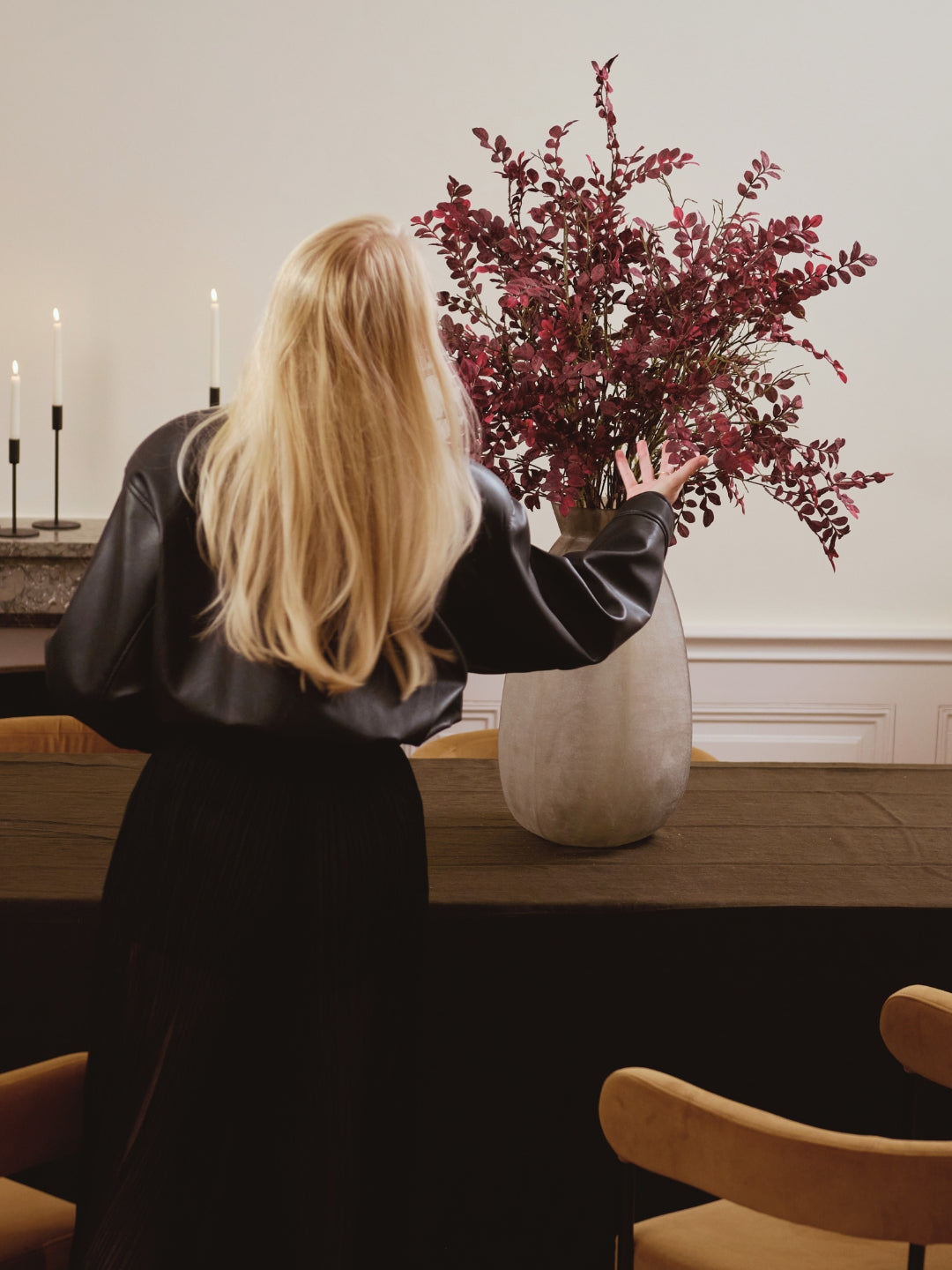
Almost any flower can look beautiful in a photo. Good lighting, the right angle, a carefully chosen vase – and suddenly a stem looks convincing on screen, even if it feels completely wrong in your hand. That is one of the reasons why we do not select our collection from catalogs. About every six weeks, we visit the brands we collaborate with. We walk through their showrooms, past finished arrangements and new collections. Afterward, we head behind the scenes to where the flowers themselves are presented. Thousands of them. This is where the Silkhaus collection begins. Not with a product list or a spreadsheet, but with a close look.
First, it must be beautiful
Our initial reaction is intuitive. Does the flower make us pause? Does it have presence? Is there something about its color, its proportions, or its shape that feels relevant right now? We view flowers as part of a much larger visual world. What is happening in interior design? In fashion? Which colors, silhouettes, and materials are starting to feel interesting? Which objects do we want to surround ourselves with?
The selection process is never just about finding the most botanically accurate replica of a flower. We look for pieces that capture the spirit of the times while remaining timeless enough to live with for many years. Sometimes that means choosing something that nature would never produce.
An oversized bloom can be completely unrealistic in its proportions and yet extraordinary. Perhaps it is exactly this exaggeration that makes it interesting. We do not try to hide the fact that they are artificial flowers. They are artificial flowers. The question is whether they are beautiful objects.

Then we take a closer look
We make our first selection with our eyes. The second, with our hands. We pick up the stem. We feel the petals. We turn the leaves over. We look closely at how everything is crafted.
Is the leaf beautifully matte, or does it have an artificial plastic sheen? Does the stem look like it was cast from a mold, or has it been finished with fine nuances of color and texture? How does the fabric of the petal feel? Does the color have depth, or does it look completely flat? Are the transitions and color gradients convincing? What does the spot where the leaf meets the stem look like?
The difference often reveals itself in exactly these small details. A beautiful artificial flower does not have to deceive us completely. But it must be convincing when you look closer.
"Cheap" is usually in the details
Some flowers look convincing from two meters away and fail the moment you pick them up. Perhaps the color is too garish. A shade of green looks more neon than botanical. The entire flower looks as if it came straight out of a single mold. The stem has the smooth, uniform surface of plastic rather than the irregularity that occurs when something has been carefully crafted.
The flowers we choose usually contain significantly more handwork. They are partially handmade or individually finished by hand. Leaves and petals show more variation. The colors have more depth. The details look deliberately designed, rather than like a single, uniformly mass-produced part.
This handwork can also make them more delicate. And that is exactly where the balance lies. We want finesse, as it is often part of what makes a flower beautiful. However, a flower at Silkhaus must also be packable, shippable throughout Switzerland, unpackable, and arrangable in someone's home. Beauty that cannot survive the journey is not enough.

From three thousand to one hundred
The scope of our selection perhaps best explains what curation means to us. A single brand might have a collection of around 3,000 flowers and stems. Of those, we might select 100 or 200. Not because the others are necessarily bad. But because Silkhaus is not intended to offer everything.
The value lies in the selection. Our customers shouldn't have to scroll through 3,000 options and figure out for themselves which hydrangea has the most convincing leaves or which branch works best in an interior. That is our job. A collection only becomes interesting when someone has made decisions.
Every manufacturer has different strengths
The fact that Silkhaus curates rather than produces itself has a major advantage: we are not tied to a single way of making flowers. We can compare the strongest European brands and choose from each what they do exceptionally well.
Silk-ka is often our go-to for an especially high degree of realism and sophistication. The details can be extraordinary – the coloring, the construction, the craftsmanship.
PURE is particularly strong with "Real Touch" florals. Here, the haptic feel of the petals becomes part of the experience.
Emerald has a different energy. Their collections are often more trend-driven, more expressive, and full of statement stems that can completely change a room.
We don't want the entire collection of a brand. We want their best pieces. This difference is fundamental for Silkhaus. Almost anything can look good in a photo. That is why we keep returning to the showrooms. There is simply no substitute for holding a stem in your hand. You have to see how the color behaves in real light. You have to touch the surface. Turn the leaf over. See the thickness of a petal and the construction of a stem.

The same standard applies to the Haus Collection
The selection is only the first level. When I put together a Haus Collection, I approach it similarly to an interior – or even an outfit. More is not automatically better for me. Traditional floristry can sometimes feel very pleasant: many different flowers, carefully combined into a pretty bouquet. That is not the language that interests me. I am drawn to simplicity with impact.
A special vase. An expressive flower, used repeatedly. A sculptural branch. A restrained color palette. An arrangement that feels almost architectural. We call this the mono-look. Instead of combining ten different flowers just because we can, we reduce. We look for the point where the arrangement becomes clearer, stronger, and more expressive.
By the same principle, a simple outfit can have more impact than one that is overdone. Restraint gives the individual pieces space to speak for themselves.
Curation is the product
Silkhaus sells artificial flowers. But more and more, I think that the curation is the actual product. There will always be more flowers. More colors. More varieties. More collections. More suppliers. But "more" is not what Silkhaus is meant to offer. I want someone to come to our website and feel: the difficult part is already done.
That someone stood in front of thousands of stems, looked closely, touched them, rejected most, and selected the ones that are worth bringing home.
Because in the end, the standard is quite simple. Would I want to have this in my own home? If the answer is no, then it does not belong in your home either. That is the Silkhaus selection standard. And that is ultimately what Silkhaus aims to earn: your trust.


